

.jpg)
The Integration of TPU Calendered Films and High-Frequency Welding: Revolutionizing Advanced Flexible Manufacturing
By combining molecular-level fusion with functional stratified design, the synergy between TPU calendered films and high-frequency welding technology has transcended traditional material processing limitations, emerging as a core innovation in high-end flexible manufacturing. At its essence, this technology leverages electromagnetic induction-driven molecular chain reconstruction and gradient performance enhancement through co-extrusion, achieving simultaneous improvements in material functionality and production efficiency.
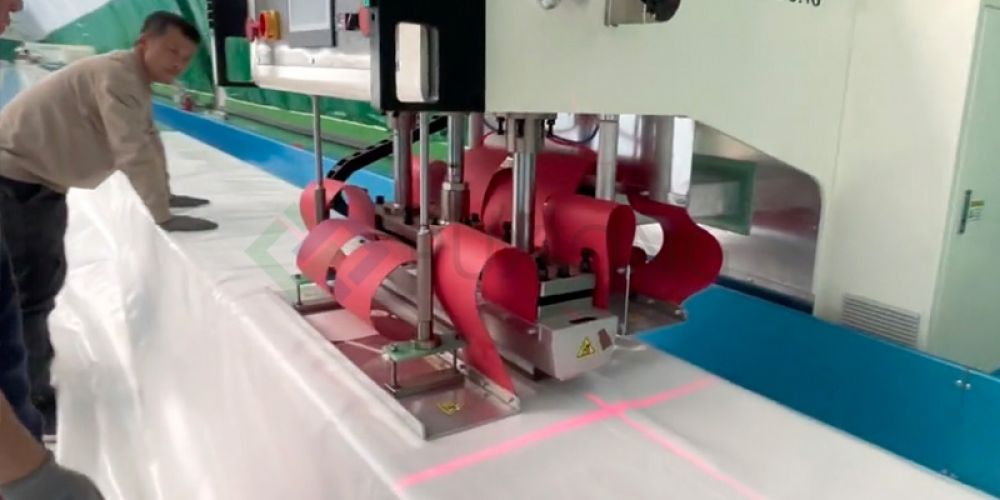
Traditional hot-melt welding relies on external heat sources, often causing material deformation or interfacial delamination. In contrast, high-frequency welding excites the polarization of TPU molecular chains via electromagnetic fields, generating uniform frictional heat at contact surfaces under pressure. This triggers cross-penetration and reconstruction of molecular chains, eliminating adhesives or high-temperature tools.
Multi-layer co-extrusion endows TPU films with stratified functionality, integrating wear-resistant, reinforcement, and sealing layers. Each layer’s properties are gradient-enhanced during high-frequency welding:
1. Wear-resistant layer (polyether-based TPU): Maintains flexibility in subzero environments.
2. Reinforcement layer (polyester-based TPU): High puncture resistance for durability.
3. Sealing layer: Molecular chain reconstruction creates flawless, airtight seams surpassing traditional methods.
During welding, molecular chains from different layers form gradient transition zones under pressure, preserving layer-specific traits while strengthening weld integrity through molecular entanglement.
The integration of high-frequency welding and co-extrusion drives transformative advancements in weather resistance, functional integration, and design freedom:
1. Enhanced Weather Resistance:
2. Functional Integration:
3. Customization Capabilities:
.jpg)
The applications of PVDF membrane materials—involving processes such as coating, sanding, and welding—in the environmental protection…
.jpg)
I. Advantages of Grinding and Welding PVDF-Coated Membrane Fabric 1. Improved Weldability: Grinding removes the surface…
In the field of modern architecture, the construction of large-scale venues requires not only meeting functional…
The advantages of high-frequency welding for tensile membrane structures primarily include the following aspects: 1. **Simple…
.jpg)
Welded tensile membrane structures are widely used in landscape architecture and offer significant advantages. The following…

Gas storage bags play a vital role in industrial production by storing gases, regulating pressure, enhancing…