

.jpg)
I. Industry Background: Core Requirements for Surgical Robot Protective Sleeves
With the increasing prevalence of surgical robots (such as the da Vinci system and the Tianji orthopedic robot) in minimally invasive surgery, the need for protection for their precision robotic arms and optical systems is becoming increasingly prominent. TPU film, due to its high transparency, flexibility, biocompatibility, and chemical resistance, has become an ideal material for protective sleeves. The heat-sealing process, as a key step in the production of protective sleeves, must meet the following core requirements:
Sterile Sealing: Prevents intraoperative fluid penetration and avoids cross-infection.
Precise Fit: Adapts to the complex curved surfaces of the robot, ensuring operational flexibility.
Durability: Withstands repeated sterilization (such as plasma and ethylene oxide) and mechanical friction.
II. Heat Sealing Machine Technology
Based on heating principles and application scenarios, the heat sealing machine for surgical robot protective sleeves is primarily a high-frequency heat sealing machine:
Technology Type | Principle | Advantages | Limitations | Typical Application Scenarios
High-Frequency (RF) Heat Sealing | High-frequency electromagnetic waves heat material molecules to achieve fusion | Fast heating speed (<1 second), strong sealing, suitable for thin-layer TPU | High equipment cost, sensitive to material thickness | Da Vinci robot robotic arm protective sleeve
Recommended Choice:
High-frequency heat sealing machine: Mainstream solution, balancing efficiency and sealing, especially suitable for welding complex curved surfaces.
III. Core Technologies and Process Optimization of High-Frequency Heat Sealing Machines
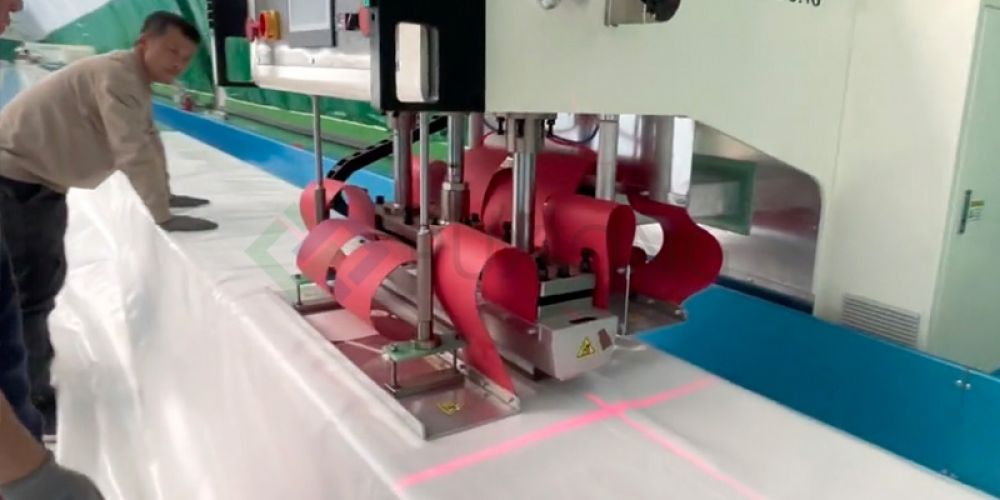
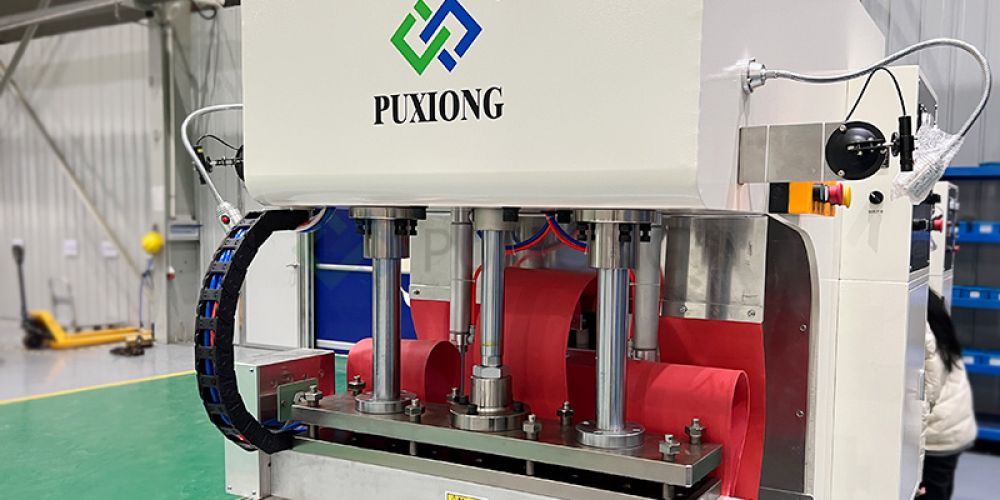
Taking the Shanghai Puxiong D04C high-frequency heat sealing machine as an example, we analyze its technical highlights and key process control points:
High-Frequency Generator Design | Employs a solid-state high-frequency oscillator, with a frequency stable at 27.12MHz (compliant with international industrial standards), avoiding electromagnetic interference affecting robot electronic components.
Adjustable output power (1-8kW), adaptable to the welding needs of 0.1-3mm thick TPU films.
Custom Mold and Material Matching
Mold Material: Imported aluminum alloy (e.g., 7075-T6), precision CNC machined, hard chrome plated, improving wear resistance by 3 times.
Mold Design:
Curved Surface Adaptation: Reverse modeling based on 3D data from the robotic arm to ensure a protective sleeve fit >95%.
Ventilation Groove Optimization: A 0.2mm wide, 0.5mm deep mesh-like ventilation groove is designed on the welding surface to prevent air bubble formation.
Material Compatibility: Supports medical-grade TPU films such as Covestro Platilon® and BASF Elastollan®, with a melt flow index (MFR) controlled between 5-15g/10min.
Process Parameter Control
Temperature: Real-time monitoring of the mold surface temperature using an infrared thermometer to ensure the TPU melting temperature is between 190-210℃ (below the decomposition temperature of 230℃).
Pressure: A pneumatic-hydraulic booster cylinder provides adjustable pressure from 0.5-1.5MPa to ensure uniform contact on the welding surface.
Time: Welding cycle controlled within 0.8-2 seconds, cooling time 1-3 seconds to prevent material embrittlement.
Key Techniques:
Preheating: For thick TPU (>1.5mm), preheat at 60℃ to reduce welding stress.
Segmented Welding: For long protective sleeves (such as full-length robotic arm covers), segmented welding is used, with each segment overlapping by 2mm to avoid incomplete welding.
Quality Inspection and Traceability
Online Inspection: Integrated CCD vision system automatically identifies welding defects (such as charring, lack of fusion), defect rate <0.1%.
Offline Testing:
Sealing: Microbial penetration test according to ISO 846 standard to ensure no bacterial intrusion.
Tensile Strength Test: Tensile strength of welded parts must be ≥18MPa (far exceeding the industry standard of 12MPa).
Data Traceability: Welding parameters, mold number, and operator information are recorded for each batch of products, supporting ISO 13485 quality system traceability.
IV. Future Trends: Intelligent and Green Manufacturing
Sustainable Materials and Processes
Biodegradable TPU: Developing TPU composite materials based on polylactic acid (PLA) to support post-operative incineration of protective sleeves, reducing medical waste.
Low-Energy Heat Sealing: Utilizing electromagnetic induction heating technology, energy utilization is increased to 90% (compared to 65% for traditional high-frequency heat sealing).
Modular Design: The heat sealing machine integrates a rapid mold change system, supporting mold changes for different protective sleeve models within 10 minutes, adapting to the needs of multi-variety, small-batch production.
V. Selection and Procurement Recommendations
Key Indicators
Welding Accuracy: Within ±0.1mm, ensuring seamless bonding between the protective sleeve and the robot.
Sealing Performance: Passes IPX7 waterproof test (no leakage after immersion in 1 meter of water for 30 minutes).
Certification: Equipment must comply with CE, FDA, and ISO 13485 standards.
Supplier Selection
Shanghai Puxiong.
Cost Analysis
Equipment Investment: High-frequency heat sealing machine.
Long-term benefits: Automated production can reduce labor costs by 30%, and the implicit benefits from improved yield rates are even more significant.
Conclusion: The TPU film surgical robot protective sleeve heat sealing machine is a key component of medical device manufacturing, and its technological iteration is developing towards higher precision, intelligence, and green practices. Enterprises need to combine their own needs to choose appropriate technology routes and suppliers to gain a competitive edge in the fierce market competition.
.jpg)
The applications of PVDF membrane materials—involving processes such as coating, sanding, and welding—in the environmental protection…
.jpg)
I. Advantages of Grinding and Welding PVDF-Coated Membrane Fabric 1. Improved Weldability: Grinding removes the surface…
In the field of modern architecture, the construction of large-scale venues requires not only meeting functional…
The advantages of high-frequency welding for tensile membrane structures primarily include the following aspects: 1. **Simple…
.jpg)
Welded tensile membrane structures are widely used in landscape architecture and offer significant advantages. The following…

Gas storage bags play a vital role in industrial production by storing gases, regulating pressure, enhancing…