


The selection of high-frequency heat sealing machines for oil boom applications is primarily based on their core advantages, including high welding strength, excellent sealing performance, high efficiency, flexible operation, and strong adaptability. A detailed analysis follows:
High Welding Strength and Excellent Sealing Performance:
**Molecular-Level Welding:** High-frequency heat sealing machines utilize high-frequency electromagnetic fields to polarize and generate heat through friction in PVC, PU, and other film materials, achieving molecular-level welding. The weld strength approaches or exceeds that of the base material, ensuring that the oil boom will not experience oil leakage due to seam cracking during long-term use.
Strong Weather Resistance: The welded area exhibits excellent sealing performance, withstanding extreme temperatures from -30℃ to +70℃, making it suitable for long-term use in marine environments and meeting the stringent durability requirements of oil booms.
High Welding Efficiency, Suitable for Large-Scale Production:
**Rapid Welding:** High-frequency heat sealing machines can weld at speeds of 5-15 meters per minute, increasing efficiency by 3-5 times compared to traditional hot air gun welding, significantly shortening the oil boom production cycle.
One-Step Molding: Supports simultaneous welding and cutting, eliminating the need for secondary cutting processes, reducing manual intervention, and improving production consistency.
One-Step Molding: Supports simultaneous welding and cutting, eliminating the need for secondary cutting processes, reducing manual intervention, and improving production consistency. Flexible operation, adaptable to complex structures.
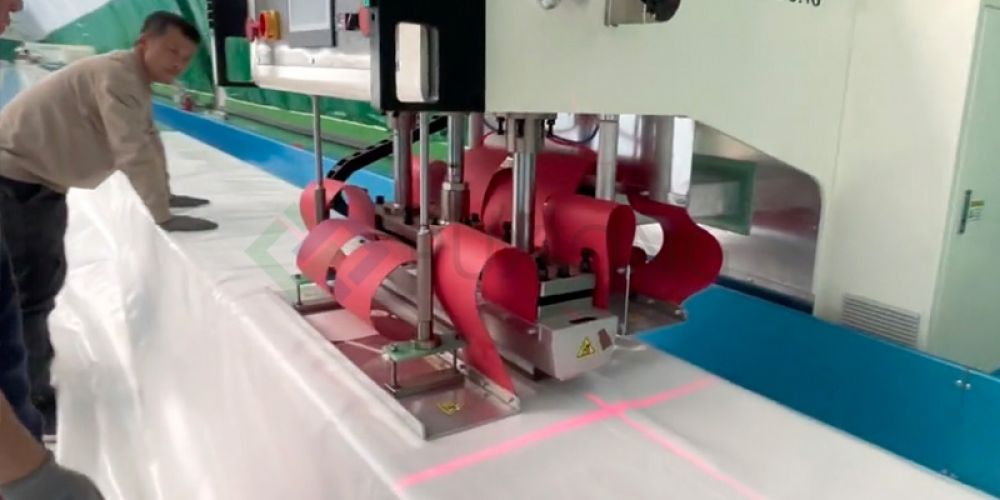
Customized molds: Customized molds enable precise processing of complex welds such as straight lines, arcs, and rings, meeting the assembly needs of components like oil boom floats, skirts, and counterweight chains.
Visual positioning system: Some models are equipped with induction plates or visual positioning devices to help operators quickly locate materials and improve welding accuracy.
High adaptability, supports multi-layer material welding.
Composite material compatibility: Can weld multiple layers of materials such as PVC coated cloth, TPU film, and rubber cloth, meeting the comprehensive requirements of oil booms for strength, oil resistance, and weather resistance.
Thickness self-adaptation: By adjusting parameters such as current and pressure, it can weld membrane materials of different thicknesses (e.g., 0.5mm-5mm), adapting to the thickness requirements of different components of the oil boom.
Environmentally friendly and safe, compliant with industry standards.
Pollution-free welding: No solvent-based adhesives are used throughout the process, avoiding volatile organic compound (VOC) emissions and meeting ISO 14001 environmental management system requirements.
Spark suppression technology: Equipped with an NL5557 spark protection device, it cuts off the high-frequency output within 0.1 seconds when the mold sparks, preventing the membrane material from burning through or causing a fire.
.jpg)
The applications of PVDF membrane materials—involving processes such as coating, sanding, and welding—in the environmental protection…
.jpg)
I. Advantages of Grinding and Welding PVDF-Coated Membrane Fabric 1. Improved Weldability: Grinding removes the surface…
In the field of modern architecture, the construction of large-scale venues requires not only meeting functional…
The advantages of high-frequency welding for tensile membrane structures primarily include the following aspects: 1. **Simple…
.jpg)
Welded tensile membrane structures are widely used in landscape architecture and offer significant advantages. The following…

Gas storage bags play a vital role in industrial production by storing gases, regulating pressure, enhancing…