

.jpg)
The combination of TPU calendered film and high-frequency welding technology, through "molecular-level fusion" and "functional layered design," breaks through the limitations of traditional material processing and has become a core process in the field of high-end flexible manufacturing. Its core logic lies in: driving molecular chain reconstruction through electromagnetic induction, achieving performance gradient enhancement through co-extrusion structures, and ultimately achieving a dual improvement in material functionality and manufacturing efficiency.
I. High-Frequency Welding: "Seamless Welding" at the Molecular Level
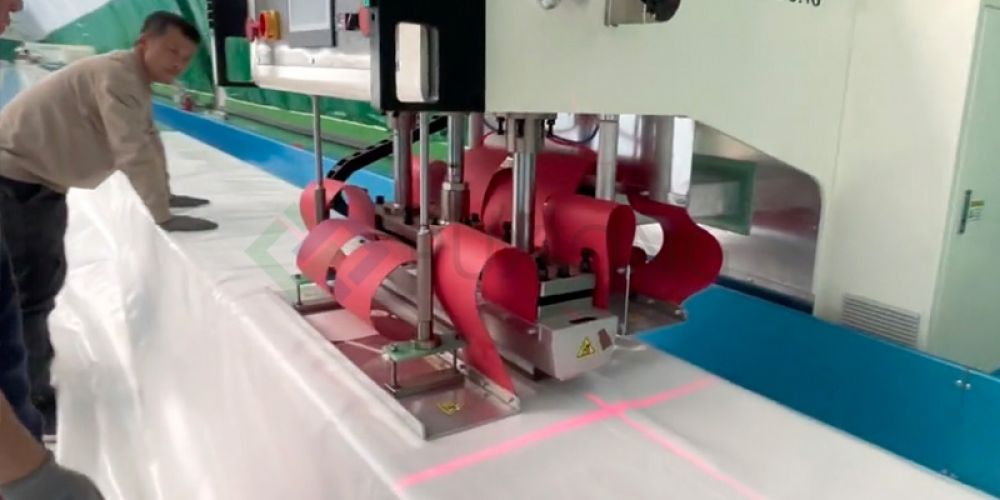
Traditional hot-melt welding relies on external heat sources, easily leading to material deformation or interface delamination. High-frequency welding, on the other hand, excites the polarization movement of TPU molecular chains through an electromagnetic field, causing the molecules at the contact surface to generate uniform frictional heat under pressure, forming cross-penetration and reconstruction of molecular chains. This process requires no adhesives or high-temperature heat sources, and the weld seam forms a continuous molecular structure with the base material, completely eliminating the risk of delamination. Simultaneously, the heat-affected zone is extremely small, making it suitable for precision structural processing.
II. Co-extrusion Structure: The "Material Code" of Functional Layering
Multi-layer co-extrusion technology endows TPU films with the flexibility of "layered design." Through co-extrusion, the membrane can integrate functional layers such as abrasion-resistant layers, reinforcing layers, and sealing layers. The properties of each layer are enhanced through gradient reinforcement during high-frequency welding:
1. Abrasion-resistant layer (polyether-based TPU): Low-temperature flexibility, adaptable to extreme environments.
2. Reinforcing layer (polyester-based TPU): High-strength puncture resistance, improving overall durability.
3. Sealing layer: Seamless weld seam formed after molecular chain reconstruction, offering superior airtightness compared to traditional processes. During welding, the molecular chains of different functional layers form a gradient transition zone under pressure, preserving the properties of each layer while strengthening the weld seam performance through molecular entanglement.
III. Performance Breakthrough: A Leap from Single to Composite
The combination of high-frequency welding and co-extrusion structure enables TPU membranes to achieve a qualitative leap in weather resistance, functional integration, and design freedom.
1. Enhanced Weather Resistance: The welded membrane can simultaneously withstand polar low temperatures and desert high temperatures, with significantly improved anti-aging properties.
2. Functional Integration: Through co-extrusion, self-healing coatings, conductive layers, or photochromic layers can be integrated into the film, achieving structural-functional integration after high-frequency welding.
3. Customized Services: Supports the processing of complex shapes for transparent and colored films, such as one-time molding of curved surfaces and three-dimensional structures, meeting the personalized needs of smart wearables, medical devices, and other scenarios.
.jpg)
The applications of PVDF membrane materials—involving processes such as coating, sanding, and welding—in the environmental protection…
.jpg)
I. Advantages of Grinding and Welding PVDF-Coated Membrane Fabric 1. Improved Weldability: Grinding removes the surface…
In the field of modern architecture, the construction of large-scale venues requires not only meeting functional…
The advantages of high-frequency welding for tensile membrane structures primarily include the following aspects: 1. **Simple…
.jpg)
Welded tensile membrane structures are widely used in landscape architecture and offer significant advantages. The following…

Gas storage bags play a vital role in industrial production by storing gases, regulating pressure, enhancing…